Commission Cycle for Beginners: A Complete Guide to Getting Started in 2026
New to affiliate marketing? Learn how Commission Cycle works for beginners, including traffic, Instagram, YouTube, AI tools, leads, commissions and scaling.

Key Takeaways
- Commission Cycle is an affiliate marketing training program built around traffic generation and a reinvestment loop — not a guaranteed-income shortcut.
- The core model focuses on four levers: Leads × Conversions × Average $ Per Sale × Average Sales Per Customer.
- The 2026 launch includes beginner-focused sessions, including a 'Newbie's Guide to Affiliate Marketing' and viral post templates for zero-follower starts.
- Traffic comes primarily from Instagram and YouTube, supported by AI content tools, ManyChat automation, and shareable resources.
- At $2,497 (or 6 × $497 = $2,982), beginners should evaluate budget and implementation willingness carefully before purchasing.
Pros & Highlights
- Structured system — beginners don't start with a completely blank page
- 2026 launch includes specific beginner-oriented affiliate marketing training
- AI assistance can reduce content production time for newcomers
- Multiple traffic options (Instagram & YouTube) are accessible
- No need to create your own product — promotes existing affiliate offers
- Scalable reinvestment model designed to grow as commissions are earned
Cons & Drawbacks
- High price ($2,497) is a significant investment for a beginner
- Results and income are not guaranteed — implementation is required
- Requires consistent content creation or distribution
- Affiliate marketing has a real learning curve
- Building organic traffic takes time and patience
- AI isn't a magic button — it speeds production but doesn't guarantee profit
Affiliate Disclosure: This article may contain affiliate links. If you purchase Commission Cycle through a link on this page, I may receive a commission at no additional cost to you.
If you're completely new to affiliate marketing, you may be wondering whether Commission Cycle is something you can actually understand and use as a beginner. The good news is that the basic concept is relatively straightforward.
Commission Cycle is an affiliate marketing training program built around a simple idea: generate traffic, turn that traffic into affiliate commissions, and reinvest part of those commissions into the area of the business that can produce more growth. The official program describes four key growth levers: leads, conversions, average dollars per sale, and average number of sales per customer.
This beginner's guide explains Commission Cycle in plain English, including how the model works, what you'll need to get started, how traffic fits into the system, how AI can help, and what beginners should consider before investing.
What Is Commission Cycle?
Commission Cycle is an affiliate marketing training program associated with Mark Ling. Instead of requiring you to create your own product, the basic affiliate marketing model is to promote products created by other businesses and earn a commission when qualifying sales occur.
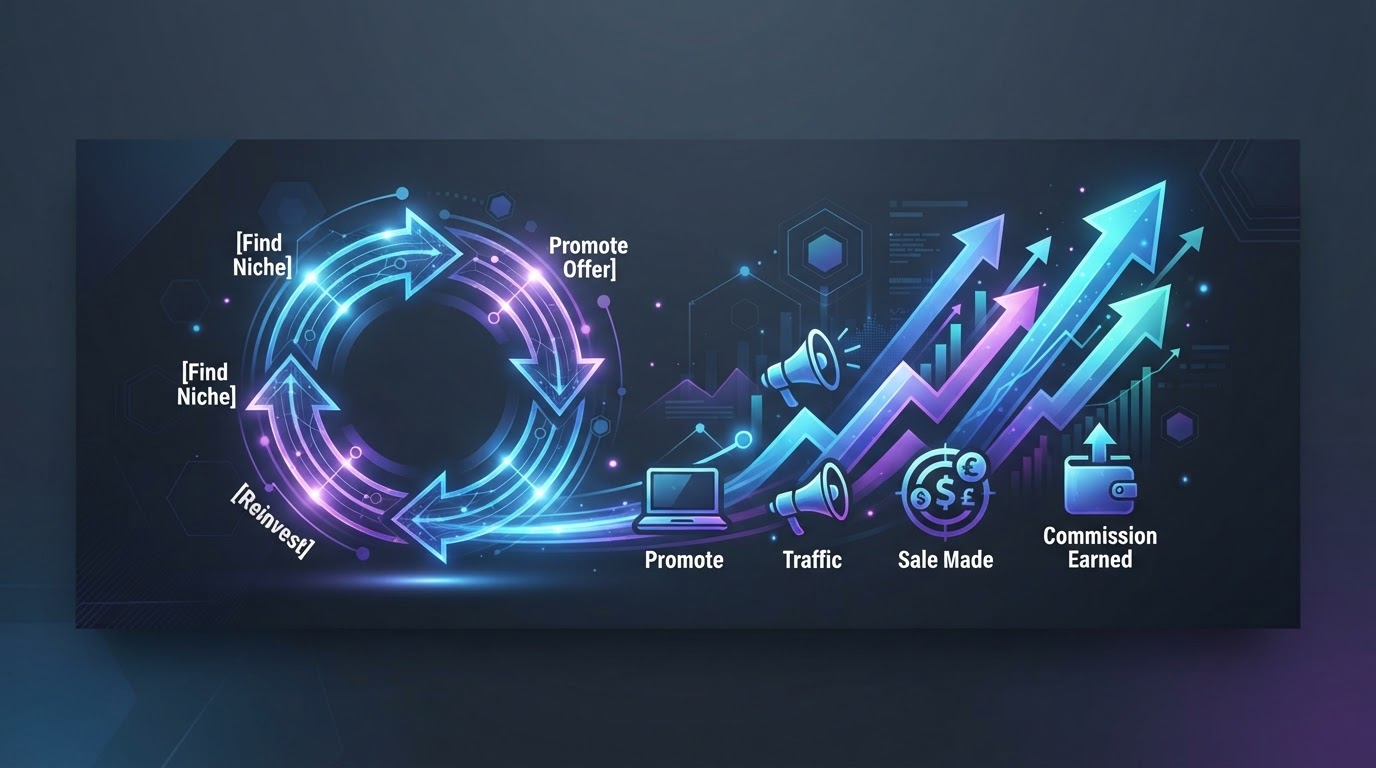
Commission Cycle adds a scaling methodology on top of that. The official program describes the process as a reinvestment loop: Leads → Sales → Commissions → Reinvestment → More Leads/Sales → More Commissions. The four variables at the center are leads, conversions, average dollars per sale, and average number of sales per customer. The idea is to put part of the commission back into whichever of those areas is currently the most economical to improve.
Is Commission Cycle Suitable for Beginners?
It can be. The 2026 launch specifically includes a session titled "Secrets of a Super Affiliate Millionaire (Newbie's Guide to Affiliate Marketing)", indicating that beginner-focused training is part of the launch.
However, beginners should have realistic expectations. Commission Cycle doesn't mean: buy a course → automatically make money. A more realistic interpretation is: learn a system → implement it → generate traffic → test → make sales → analyze results → reinvest → improve. Affiliate marketing still requires time, learning and consistent execution.
Want to see the official Commission Cycle offer?
Review the current pricing, training structure, and beginner sessions before you decide.
Check the Official Offer →Affiliate Marketing Explained for Beginners
Before understanding Commission Cycle, let's understand affiliate marketing. Imagine a company sells a product for $100. The company gives affiliates a special tracking link. You promote that product. Someone clicks your link and purchases. The company records that sale and pays you a commission according to its affiliate terms.
The basic process is: Product → Your Affiliate Link → Your Content → Potential Customer → Purchase → Affiliate Commission. You don't necessarily need to create the product, handle inventory, process payments, or provide the product yourself. That's one reason affiliate marketing is attractive to beginners.
How Commission Cycle Works
The simplest version of the Commission Cycle model is:
- Choose an audience or niche.
- Find relevant affiliate offers.
- Create useful content.
- Generate traffic.
- Turn visitors into leads or customers.
- Earn affiliate commissions.
- Reinvest part of those commissions.
- Improve whichever growth lever offers the best opportunity.
- Repeat.
That's the cycle.
The Four Numbers Beginners Should Understand
One of the most important things to learn from the Commission Cycle model is that affiliate marketing isn't just about getting more visitors. There are four major variables.
1. Leads
A lead is someone who has shown interest in what you're offering. For example, someone might join your email list, request a free guide, register for a webinar, start a conversation, or submit a form. More qualified leads can create more opportunities for sales.
2. Conversions
Conversion means turning an interested person into a customer. For example: 100 leads → 5 customers means your conversion rate is 5%. If you improve the conversion rate to 8%, the same 100 leads could potentially produce more customers. That's why getting more traffic isn't always the answer — sometimes improving your conversion process is more valuable.
3. Average Dollars Per Sale
Not every affiliate product pays the same commission. For example: Offer A → $20 commission, Offer B → $100 commission, Offer C → $500 commission. The right offer depends on your audience, conversion rates and affiliate terms. The Commission Cycle methodology encourages affiliates to consider the economics of each sale rather than focusing only on traffic volume.
4. Average Number of Sales Per Customer
The fourth variable is customer value. Suppose one customer buys one product, but another customer purchases several relevant products over time. The second customer can potentially be more valuable. Therefore, affiliates can look for appropriate ways to increase the value generated from each customer.
The Commission Cycle Formula
The model can be simplified as: Leads × Conversions × Average $ Per Sale × Average Sales Per Customer. You don't necessarily need to become a math expert. The important lesson is: small improvements across multiple parts of the funnel can significantly affect the overall result.
A Beginner-Friendly Example
Let's say you generate 500 leads. Your conversion rate is 2%, which gives you 10 sales. Suppose the average commission is $100 — you generate $1,000. Now imagine you reinvest part of that money into improving your marketing. You might invest in better content, more traffic, a better landing page, email marketing, automation, or better creative. If your improved system generates more leads or sales, the next commission amount could be larger. That's the cycle. This is a hypothetical example, not a prediction of actual Commission Cycle earnings.
See how the Commission Cycle method works for beginners
Review the official offer, beginner training sessions, and current pricing.
View Official Offer →What Do You Need to Start?
A beginner doesn't necessarily need a huge business setup. You'll generally need:
- A Niche: Choose a topic you want to create content around — personal development, online business, affiliate marketing, AI, productivity, fitness, or finance. The Commission Cycle training leads with personal development and also covers the make-money-online niche, while the official page says the method can be applied to other niches.
- An Affiliate Offer: You need something relevant to promote — software, courses, digital products, physical products, or subscription services. Always check the individual affiliate program's terms before promoting an offer.
- A Traffic Source: You need people to see your content. Commission Cycle's 2026 materials emphasize Instagram and YouTube, including short-form content and social posts. You can potentially build traffic through Instagram, YouTube, SEO, email, communities, or paid advertising.
- A Way to Capture Leads: You can use landing pages, lead magnets, email forms, webinar registration, or automated conversations. A simple lead magnet could be "10 Affiliate Marketing Mistakes Beginners Should Avoid" — someone receives the guide in exchange for joining your list.
Do You Need an Email List?
Not necessarily. The official Commission Cycle materials specifically describe a strategy that doesn't require an existing email list. However, building an email list is part of the broader scaling approach. For beginners, I would still recommend building one. Why? Because an audience on Instagram or YouTube can disappear if the platform changes its algorithm. An email list gives you another way to communicate with people who have already shown interest.
Commission Cycle and Instagram
Instagram is one of the major traffic channels emphasized by the current Commission Cycle launch. A beginner could start with 3–5 short videos per week. Content could include tips, tutorials, mistakes, questions, quick strategies, case studies, and educational content. For example: Hook — "3 affiliate marketing mistakes beginners make." Then provide useful information. At the end: "Comment GUIDE if you'd like my free checklist." This creates an opportunity to turn engagement into a lead.
Commission Cycle and YouTube
YouTube can be another powerful traffic source. Beginners can create tutorials, reviews, how-to videos, comparisons, educational videos, and Shorts. For example: Video — "How to Start Affiliate Marketing With No Product" → Viewer watches → Viewer visits your description/profile → Downloads your free guide → Joins your email list → Receives helpful content → Eventually sees a relevant affiliate offer. This creates a simple funnel.
The "One-Word Reply" Concept
One of the opening Commission Cycle sessions in the 2026 launch is titled "How to Get Paid from 1 Word Replies." The official launch page says the Commission Cycle Method itself is revealed during this session. For a beginner, the concept can be understood as using a simple CTA to encourage engagement. For example: "Want my free affiliate checklist? Comment CHECKLIST." Someone replies: CHECKLIST. That interaction can then lead to: Conversation → Resource → Lead → Follow-up. The specific implementation and tools are part of the training.
Using Automation
Automation can become useful once your content starts generating lots of interactions. For example: Instagram post → Someone comments "GUIDE" → Automation sends instructions → Person receives the resource → Person enters your funnel. Instead of manually responding to every comment, automation can handle repetitive tasks. The current Commission Cycle materials specifically mention ManyChat automation among the promotional strategies.
Explore the beginner-friendly Commission Cycle system
Review the official training, AI tools, and traffic strategies before you decide.
Check the Official Offer →How AI Can Help Beginners
AI can significantly reduce the amount of time required for content creation. The Commission Cycle materials describe AI-assisted resources covering areas such as research, scripts, social posts, videos, and images. For example, a beginner could use AI to help create topic ideas ("Give me 20 Instagram Reel ideas about affiliate marketing for beginners"), scripts ("Write a 45-second educational Reel script"), hooks ("Give me 10 attention-grabbing hooks"), captions ("Create an Instagram caption explaining this strategy"), or video concepts ("Turn this article into five YouTube Shorts"). AI doesn't replace strategy, but it can speed up production.
A Simple Beginner Funnel
Here's a simple funnel you can understand without technical jargon: Instagram / YouTube → Useful Content → Free Resource → Email or Conversation → Helpful Follow-Up → Affiliate Recommendation → Sale → Commission → Reinvestment → More Content / Traffic → Repeat.
What Should Beginners Promote?
Don't choose an affiliate product simply because it offers a large commission. Consider: relevance (does it solve a problem your audience has?), quality (would you recommend it even without a commission?), price (is it appropriate for your audience?), commission (does the economics make sense?), support (does the vendor provide affiliate materials?), and reputation (is the company/product trustworthy?). Your reputation is more valuable than one commission.
How Much Does Commission Cycle Cost?
The current official 2026 affiliate page lists Commission Cycle at $2,497 or 6 payments of $497. The payment plan therefore totals $2,982. The affiliate page also states that affiliates can earn 50% commission after transaction fees, with payouts advertised at up to $1,200+ per sale. For a beginner, this is an important consideration. Don't purchase a high-ticket training program using money you cannot afford to lose.
Is Commission Cycle Free?
No. Commission Cycle itself is a paid training program. You can, however, learn the general principles of affiliate marketing without purchasing it. There are many free resources available online. The potential value of a paid program is having a more structured system, training, tools and resources in one place.
How Long Does It Take to Make Money?
There is no guaranteed timeline. A beginner might spend weeks learning before getting their first sale. Another person with an existing audience might generate sales faster. Results can depend on niche, content quality, traffic, offer, audience, conversion rate, consistency, experience, and follow-up. Be skeptical of anyone promising "You'll make $10,000 in 30 days." Affiliate marketing isn't that predictable.
Verify the official claims and beginner training yourself
Review pricing, beginner sessions, refund policy, and product details.
View Official Offer →Common Beginner Mistakes
- Mistake #1: Trying to Sell Immediately. Don't make every post a sales pitch. Teach first, build trust, then recommend relevant products.
- Mistake #2: Chasing Every Niche. Don't create an Instagram account about fitness, finance, AI, cooking, travel, and marketing all at once. Start with a clear audience.
- Mistake #3: Focusing Only on Followers. 10,000 followers don't necessarily equal 10,000 customers. Focus on engagement, leads, clicks, conversions, and revenue.
- Mistake #4: Creating Content Without a CTA. If you want people to take action, tell them what to do — "Comment GUIDE," "Watch the full tutorial," "Get the free checklist," "Join the free training."
- Mistake #5: Giving Up Too Early. You may publish 20 videos and get almost no traction. That doesn't necessarily mean the strategy doesn't work. Analyze hooks, topics, retention, engagement, click-through rate, and conversion — then improve.
Should Beginners Use Paid Advertising?
You can, but I wouldn't recommend starting there unless you understand the fundamentals. Organic content can help you learn what people respond to, which hooks work, which offers get clicks, and which topics attract leads. Once you identify something that works, you can potentially consider paid traffic. The Commission Cycle model emphasizes the principle of investing in whichever growth opportunity is currently underpriced, which can include paid traffic or building organic assets.
A Simple 30-Day Beginner Plan
If you're starting from zero, here's a simple framework.
Week 1: Foundation
Choose your niche, audience, affiliate offer, and social platform. Create your Instagram account, YouTube channel, basic landing page, and lead magnet.
Week 2: Content
Publish 3–5 short videos and 1–2 longer educational posts/videos, plus several useful social posts. Focus on solving problems. Don't obsess over sales.
Week 3: Lead Generation
Add CTAs. For example: "Comment GUIDE" or "Get the free checklist." Start collecting leads.
Week 4: Optimize
Look at your numbers. Ask: Which post got the most views? Which generated comments? Which generated leads? Which generated clicks? Which generated sales? Then create more content around what is working.
Beginner Metrics to Track
| Metric | What It Tells You |
|---|---|
| Views | How much attention you're getting |
| Engagement | Whether people care |
| Leads | How many prospects you're generating |
| Clicks | Whether people take action |
| Conversion Rate | How well your funnel converts |
| Sales | Whether your offer works |
| Commission | How much you're earning |
| Cost | How much you're spending |
This allows you to see where your biggest problem is.
What If You Get Traffic but No Sales?
Don't immediately conclude "Affiliate marketing doesn't work." Instead diagnose the funnel:
- Lots of traffic + few leads → Improve CTA/lead magnet.
- Lots of leads + few clicks → Improve email/content.
- Lots of clicks + no sales → Evaluate the offer or sales page.
- Sales + low commissions → Consider whether a better offer exists.
This is exactly why understanding the four Commission Cycle levers can be useful.
What If You Don't Have Any Followers?
That's okay. Everyone starts somewhere. You can build from zero using YouTube Shorts, Instagram Reels, search-friendly YouTube videos, SEO articles, helpful social posts, and communities where promotion is allowed. The current Commission Cycle launch even includes a session called "27 Viral Post Templates That Turn Comments into Cash (Start From Zero Followers)." The important thing is to focus on creating content people actually want.
Can You Build a Faceless Commission Cycle Business?
Potentially, yes. You don't necessarily have to appear on camera. A faceless content system could use AI-assisted scripts, voiceovers, screen recordings, stock footage, AI-generated visuals, tutorials, or text-based videos. For example: AI research → Script → Voiceover → Visuals → Short video → Instagram / YouTube. The official program's AI resources are designed to assist with research, scripts, social posts, videos and images.
Ready to explore the official Commission Cycle offer?
Review pricing, beginner training, AI tools, and refund terms before joining.
Check the Official Offer →Commission Cycle Pros for Beginners
- Structured System: You aren't starting with a completely blank page.
- Beginner-Focused Training: The 2026 launch includes specific beginner-oriented affiliate marketing content.
- AI Assistance: AI can help reduce content production time.
- Multiple Traffic Options: Instagram and YouTube are major components.
- No Need to Create Your Own Product: Affiliate marketing allows you to promote existing products.
- Scalable Model: The reinvestment approach is designed to grow as the business generates commissions.
Commission Cycle Cons for Beginners
- High Price: At $2,497, the program is a significant investment.
- Results Aren't Guaranteed: You still need to implement the system.
- Requires Content: You'll need to consistently create or distribute content.
- Requires Learning: Affiliate marketing has a learning curve.
- Traffic Takes Time: Building an audience doesn't happen overnight.
- AI Isn't a Magic Button: AI can speed up production, but it doesn't automatically create profitable campaigns.
Beginner's Commission Cycle Checklist
Before getting started, make sure you can answer "yes" to most of these:
- I understand what affiliate marketing is.
- I have selected a niche.
- I know who my audience is.
- I have a relevant affiliate offer.
- I have at least one traffic source.
- I can create useful content consistently.
- I have a basic lead-generation system.
- I understand that results aren't guaranteed.
- I can track my numbers.
- I have a realistic budget.
- I'm prepared to learn and test.
If you can check most of those boxes, you're much better positioned to start.
Is Commission Cycle Worth It for Beginners?
There's no universal answer. It could make sense if you want a structured affiliate marketing system, have the budget, are willing to implement, want to use Instagram or YouTube, want AI-assisted content tools, and understand that affiliate marketing isn't guaranteed. You may want to wait if $2,497 would create financial pressure, you're looking for guaranteed income, you don't have time to implement, you don't want to create content, or you haven't learned the basics of affiliate marketing.
The best course isn't necessarily the most expensive one. The best course is one you'll actually implement.
Final Verdict: Commission Cycle for Beginners
Commission Cycle can be understood fairly simply once you break it down. You're essentially building an affiliate marketing machine: Choose a niche → Create useful content → Generate traffic → Capture leads → Recommend relevant products → Earn commissions → Reinvest part of the money → Improve the weakest growth lever → Generate more commissions → Repeat.
The 2026 program places significant emphasis on Instagram, YouTube, social content, AI-assisted creation and automation, while its core methodology focuses on improving leads, conversions, average sale value and customer value. For beginners, the most important lesson isn't simply how to make an affiliate sale — it's learning to measure what's working, identify what's holding the business back and reinvest intelligently.
My advice? Don't view Commission Cycle as a shortcut to guaranteed income. View it as a business training system that you would still need to implement, test and improve. If you've done your research and the program fits your budget and goals, you can learn more from the official Commission Cycle offer.
Frequently Asked Questions
Quick answers to the most common questions about Commission Cycle.
Related Guides
Continue your research with these detailed guides.
Ready to learn more?
Review the official training, current pricing, and offer details before making your decision.
Check the Official Offer