How Does Commission Cycle Work? Complete Guide for 2026
How does Commission Cycle work? Learn the affiliate marketing model, traffic strategies, AI tools, Instagram, YouTube, lead generation and the reinvestment cycle.

Key Takeaways
- Commission Cycle combines affiliate marketing, traffic generation, AI-assisted content, lead generation, and a reinvestment loop into one system.
- The core 'Commission Cycle Method' focuses on four levers: Leads × Conversions × Average $ Per Sale × Average Sales Per Customer.
- Traffic comes primarily from Instagram and YouTube, supported by ManyChat automation, shareable resources, and AI content tools.
- No existing email list or website is required to start, though building an email list is recommended for long-term scaling.
- Income is never guaranteed — the system is a framework for building, measuring, and reinvesting in an affiliate business, not a magic button.
Pros & Highlights
- Structured methodology with a defined reinvestment framework
- Multiple traffic sources (Instagram & YouTube) reduce platform dependence
- AI tools accelerate research, scripts, social posts, videos and images
- No product creation required — promotes existing affiliate offers
- Can build owned audience assets (email list, YouTube subscribers)
- Reinvestment model treats affiliate marketing as a real business system
Cons & Drawbacks
- High initial price ($2,497 or 6 × $497 = $2,982)
- Results and income are not guaranteed
- Content creation still requires strategy, not just AI automation
- Traffic isn't automatic — you must build an audience or pay for ads
- High-ticket affiliate sales require trust and stronger nurturing
- Additional costs (domains, email software, ads, tools) may apply
Affiliate Disclosure: This article may contain affiliate links. If you purchase Commission Cycle through a link on this page, I may receive a commission at no additional cost to you. This does not change the information or opinions presented in this article.
If you've been researching Commission Cycle, one of the most important questions to answer before joining is simple: How does Commission Cycle actually work?
Commission Cycle is an affiliate marketing training program built around two connected ideas: generating affiliate traffic and commissions, and reinvesting part of those commissions to grow the business. The official program describes this as the Commission Cycle Method. It focuses on four business levers: leads, conversions, average dollars per sale, and average number of sales per customer. The idea is to reinvest a portion of profits into whichever lever is currently the most economical to improve.
This guide explains the model in simple terms, including the traffic strategy, AI tools, Instagram and YouTube content, lead generation, affiliate commissions and the reinvestment cycle.
How Does Commission Cycle Work? Quick Answer
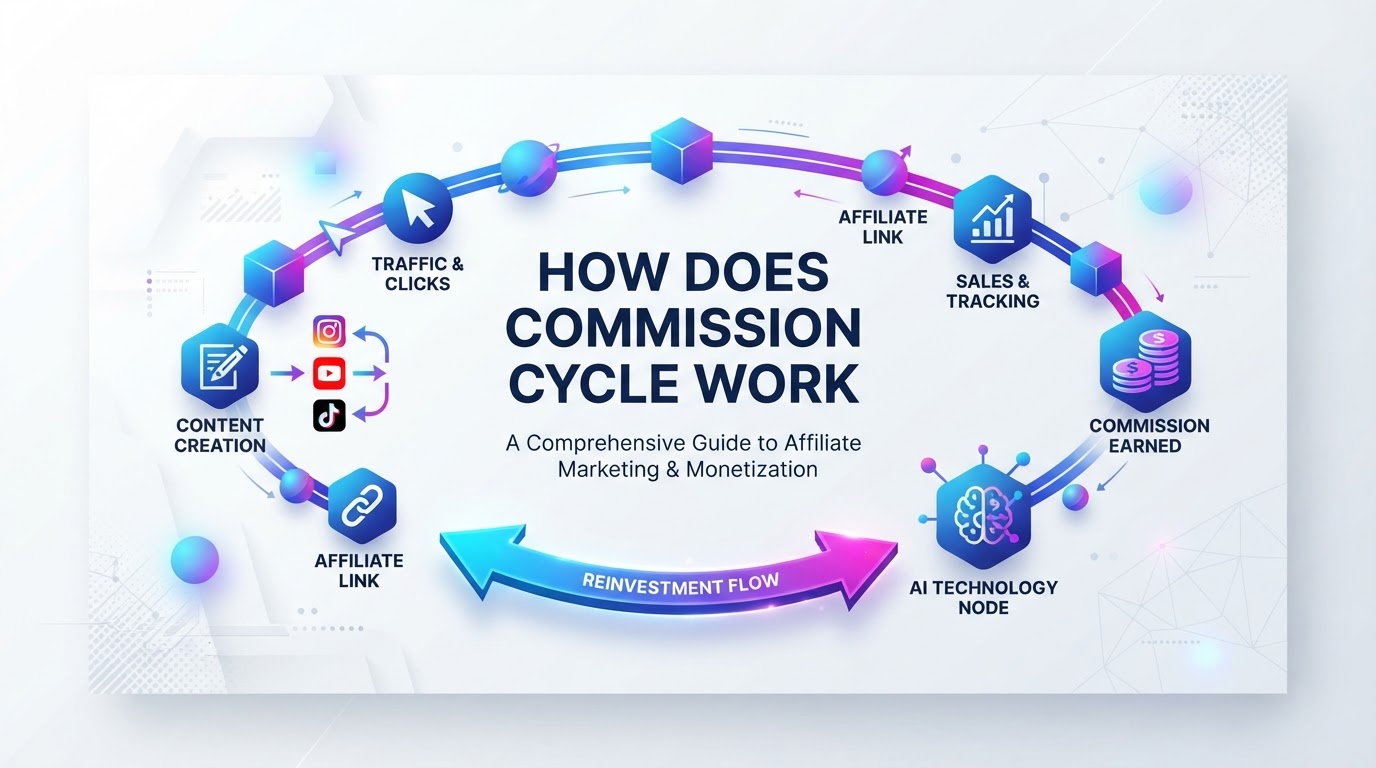
The simplest way to understand Commission Cycle is: Create Traffic → Generate Leads → Make Affiliate Sales → Earn Commissions → Reinvest Part of the Profit → Improve the Business → Generate More Commissions.
The official training combines this process with traffic strategies focused primarily on Instagram and YouTube, along with AI-assisted content creation, ManyChat automation, shareable resources and email-list building. The underlying Commission Cycle model then asks: Which part of my business can I improve most economically right now? That could be getting more leads, increasing conversions, promoting higher-value offers, or increasing the number of purchases from customers. Then part of the money the business has already generated is reinvested into that area.
Want to see how Commission Cycle works in practice?
Review the official offer, training structure, and current pricing before you decide.
Check the Official Offer →What Is Commission Cycle?
Commission Cycle is an affiliate marketing training program that teaches people how to generate affiliate commissions and then scale those commissions using the Commission Cycle model. The official description says the program teaches people to make affiliate profits from traffic strategies and then increase those commissions using the Commission Cycle methodology.
The training primarily focuses on affiliate marketing, traffic generation, Instagram, YouTube, short-form content, AI-assisted marketing, lead generation, email marketing, automation, and scaling. The program currently focuses heavily on the personal development and make-money-online niches, although the official materials state that students can apply the approach to other niches as well.
The Commission Cycle Model Explained
At the heart of the system are four variables:
- Leads: How many potential customers enter your marketing funnel?
- Conversions: How many of those leads become customers?
- Average Dollars Per Sale: How much money does each sale generate?
- Average Number of Sales Per Customer: How many purchases does the average customer make?
The official Commission Cycle formula can therefore be represented as: Leads × Conversions × Average $ Per Sale × Average Sales Per Customer. The purpose isn't simply to maximize one number. Instead, you look for the cheapest or most efficient lever to improve at that moment.
A Simple Example of the Commission Cycle
Let's imagine you generate 1,000 leads. Your conversion rate is 2%, which produces 20 sales. Suppose the average commission is $300. Your revenue would be 20 × $300 = $6,000. Now imagine you have $6,000 in commissions. Instead of simply taking all of it out of the business, the Commission Cycle concept says you could reinvest a portion into improving the weakest or cheapest-to-improve part of the system. For example: More traffic → More leads → More sales → More commissions → More reinvestment. That's the cycle.
Step 1: Choose a Market
The first part of the process is deciding who you want to reach. Commission Cycle's current training leads with the personal development niche and also covers the make-money-online/IM niche. The official page says students can choose other niches as well. For example, you could create content around personal development, motivation, productivity, mindset, goal setting, confidence, habits, affiliate marketing, AI tools, online business, digital marketing, or side hustles. The important point is to choose a market where there are People + Problems + Products.
Step 2: Find an Affiliate Offer
Instead of creating your own product, affiliate marketing allows you to promote someone else's product. The general process is: Product Owner creates the product → Affiliate promotes the product → Customer purchases → Affiliate receives a commission. This eliminates the need to create your own course, software or physical product.
Step 3: Create Content
Traffic is a major component of Commission Cycle. The official materials say traffic comes primarily from Instagram and YouTube, with social posts and short videos forming important parts of the strategy. This means content creation is central to the model. You could create Instagram Reels, YouTube videos, YouTube Shorts, educational posts, tutorials, problem/solution content, and product-related content.
See the complete Commission Cycle traffic system
Confirm current pricing, tools, and training details on the official page.
View Official Offer →Step 4: Use AI to Speed Up Content Creation
One of the more distinctive aspects of Commission Cycle is its use of AI tools. The official materials describe separate AI tools for research, scripts, social posts, videos, and images. The stated goal is to reduce the amount of manual work required to produce content. A simplified workflow looks like this: Topic → AI Research → AI Script → AI Video → AI Image/Thumbnail → Instagram / YouTube. Instead of spending hours starting from scratch, AI can help accelerate the production process.
Step 5: Generate Instagram Traffic
Instagram is one of the primary traffic sources in the Commission Cycle system. A typical strategy might look like: Create Reel → Offer useful information → Ask viewers to comment → Start a conversation → Provide a resource → Generate a lead. This is different from simply posting "Buy my affiliate product!" The goal is to create content that earns attention first.
Step 6: Use the One-Word Reply Strategy
The opening Commission Cycle session is specifically titled "How to Get Paid from 1 Word Replies." According to the official launch page, this is where the Commission Cycle Method itself is revealed. The basic concept is easy to understand. Imagine creating an Instagram Reel: "Want my free affiliate marketing checklist? Comment CHECKLIST." Someone comments: CHECKLIST. That creates an opportunity to start a conversation and deliver the resource. Instead of trying to sell immediately, you're creating a pathway from: Content → Engagement → Conversation → Lead.
Step 7: Use ManyChat Automation
Commission Cycle's official materials specifically mention ManyChat automations as part of the traffic strategy. Automation can handle repetitive interactions. For example: Person comments "CHECKLIST" → Automated response → Resource delivered → Prospect continues → Potential lead. This becomes especially useful when content begins generating hundreds or thousands of interactions.
Step 8: Create Shareable Resources
The Commission Cycle model also uses shareable resources to help spread content and generate leads. Examples could include checklists, guides, templates, tutorials, cheat sheets, videos, and free reports. For example: "Comment GUIDE and I'll send you my affiliate marketing checklist." This gives someone a reason to engage.
Curious about the one-word reply & automation system?
Review the official Commission Cycle offer to see the complete lead-generation strategy.
Check the Official Offer →Step 9: Build an Email List
Interestingly, an existing email list isn't required to start the traffic strategy. The official Commission Cycle page specifically says the strategy can work without an email list. However, the training also teaches students to build an email list because it can provide additional opportunities to monetize and scale. That's an important distinction. You don't want your entire business dependent on Instagram or YouTube. Instead, a long-term funnel could look like: Instagram / YouTube → Lead Magnet → Email List → Value + Follow-up → Affiliate Offers → Commissions.
Step 10: Make Affiliate Sales
Eventually, the goal is to convert traffic and leads into customers. The process could look like: Content → Visitor → Lead → Email/Conversation → Affiliate Offer → Customer → Commission. Your commission depends on the specific affiliate offer and its terms.
Commission Cycle Pricing
The current official Commission Cycle affiliate page lists $2,497 or 6 × $497. The payment plan totals $2,982. The official affiliate structure currently advertises 50% commission after transaction fees, with potential payouts of up to $1,200+ per sale. These are the program's stated affiliate terms and potential payout figures, not a guarantee that every affiliate will earn that amount.
Step 11: Reinvest Your Commissions
This is where Commission Cycle becomes different from simply learning affiliate marketing. Imagine you make your first $1,000. Instead of treating the entire amount as personal income, you could potentially reinvest a portion into more traffic, content, lead generation, conversion optimization, better offers, or organic assets. The objective is to create a feedback loop: Commission → Reinvestment → Better Business → More Leads/Sales → More Commission → More Reinvestment. This is the Commission Cycle.
Explore the reinvestment model inside Commission Cycle
Review the official offer to confirm pricing, training, and terms before joining.
View Official Offer →The Four Commission Cycle Levers
Let's examine each one.
Lever #1: Leads
Suppose you have 100 leads and generate 5 sales. If you increase your leads to 500 while maintaining the same conversion rate, you could potentially generate more sales. So you might invest in traffic.
Lever #2: Conversions
Maybe you already have plenty of traffic. For example, 1,000 leads but only 10 sales. Your problem may not be traffic — it could be conversion. You might focus on better messaging, follow-up, landing pages, offers, or sales process. Increasing conversion can sometimes be more economical than buying more traffic.
Lever #3: Average Dollars Per Sale
Another approach is increasing the value generated from each sale. For example, Offer A: $50 commission vs. Offer B: $500 commission. If both offers have similar conversion economics, the higher-value offer can potentially produce more revenue per customer. But higher-ticket offers may also require more trust and stronger sales processes.
Lever #4: Average Sales Per Customer
The fourth lever involves customer value. Instead of generating one sale from a customer, you may have additional relevant products or offers. For example: Product A → Product B → Product C. The exact opportunities depend on the products and affiliate terms you're working with.
Which Lever Should You Improve?
This is one of the central ideas behind the Commission Cycle. Don't automatically assume "I need more traffic." Instead ask: What's currently holding my business back? If traffic is cheap and conversion is strong, buy more traffic. If traffic is expensive but conversion is weak, improve conversion. If sales are strong but commissions are small, consider higher-value offers. If customers only buy once, look for appropriate additional offers. The idea is to find the underpriced opportunity and invest there.
Organic Traffic vs Paid Traffic
Commission Cycle doesn't appear to depend exclusively on paid advertising. The official materials mention both paid traffic and organic assets, and state that the rule is to invest in whichever opportunity is currently underpriced. That could mean paid (advertising, sponsored traffic, retargeting) or organic (YouTube, Instagram, SEO, content, audience building). The right choice depends on your numbers.
Commission Cycle and YouTube
YouTube is another major traffic channel. A simple YouTube funnel could look like: YouTube Video → Viewer → Free Resource → Email List → Affiliate Offer → Commission → Reinvestment. YouTube has an additional advantage: a useful video can potentially continue generating views long after publication.
Commission Cycle and Instagram
Instagram is particularly useful for short-form content. You might publish Reels, carousel posts, Stories, educational posts, and short tutorials. Then use a CTA such as "Comment GUIDE." That can start a conversation. The Commission Cycle system combines this type of social engagement with automation and shareable resources.
Commission Cycle and Email Marketing
Although you don't need an existing email list, building one is recommended as part of the broader strategy. Why? Because social platforms are rented distribution channels. Your email list is an audience you can communicate with more directly. A simple email sequence could be: Email 1 (deliver the resource), Email 2 (teach something useful), Email 3 (discuss a common mistake), Email 4 (introduce a relevant solution), Email 5 (share another useful strategy), Email 6 (present the affiliate offer). The goal should be to build trust rather than send constant sales pitches.
See the full Commission Cycle funnel in action
Review the official offer, training structure, and current pricing.
Check the Official Offer →Commission Cycle Example
Let's build a hypothetical example. Suppose you create an Instagram account about affiliate marketing. You publish 3 Reels per week and 2 carousel posts per week. One Reel attracts 10,000 views. From those viewers: 200 visit your profile → 50 request your free checklist → 30 join your email list → 5 click an affiliate offer → 1 purchases. If your commission is $500, you generated $500. Now imagine you reinvest part of that money into content, traffic or conversion improvements. That is the cycle. This is only an example — not a prediction of actual Commission Cycle results.
Does Commission Cycle Require a Website?
Not necessarily. The official strategy emphasizes Instagram and YouTube, and says the traffic method doesn't require an existing email list. However, having a website can still be useful for SEO, reviews, educational content, lead magnets, email capture, comparison articles, and long-term organic traffic. For example, you could build a content hub around a review page and support it with pricing, legitimacy, pros-and-cons, and strategy articles. That creates a topical content cluster.
Can Beginners Use Commission Cycle?
Yes, the training is designed to teach the methodology, and the current launch includes sessions specifically positioned for beginners, including "Secrets of a Super Affiliate Millionaire (Newbie's Guide to Affiliate Marketing)." But beginners should understand something important: the system isn't completely passive. You'll still need to learn the strategy, create content, generate traffic, build relationships, test offers, analyze results, and implement what you learn. AI can reduce some of the workload, but it doesn't eliminate the need for execution.
Can You Use Commission Cycle Without Showing Your Face?
Potentially, yes. The AI-assisted content workflow can support faceless marketing. For example: AI research → AI script → Voiceover → Stock/AI visuals → Captions → Instagram Reel. Or: AI script → Screen recording → Voiceover → YouTube video. This can be useful if you're uncomfortable appearing on camera.
How Long Does Commission Cycle Take to Work?
There is no reliable universal timeline. Some people may generate traffic quickly. Others may take months to develop an audience. Your timeline can depend on content quality, publishing frequency, niche, offer, traffic source, audience, conversion rate, and experience. Anyone promising that you'll definitely make money within a specific number of days should be treated cautiously.
Does Commission Cycle Guarantee Income?
No. This is extremely important. Commission Cycle provides a methodology and tools. It does not control your content, traffic, audience, execution, conversion rate, or market competition. Therefore, the system shouldn't be viewed as guaranteed income.
Commission Cycle Pros
- Structured Methodology: You have a defined framework.
- Multiple Traffic Sources: Instagram and YouTube are primary channels.
- AI Assistance: Research, scripts, social posts, videos and images can be accelerated with AI.
- Reinvestment Model: The system focuses on using existing profits to improve the business.
- No Product Creation Required: Affiliate marketing allows you to promote existing products.
- Can Build an Audience: Instagram, YouTube and email can become long-term traffic assets.
Commission Cycle Cons
- High Initial Price: The current listed price is $2,497.
- Results Aren't Guaranteed: You still have to execute.
- Content Creation Requires Work: AI makes production faster but doesn't eliminate strategy.
- Traffic Isn't Automatic: You must build an audience or pay for traffic.
- High-Ticket Affiliate Marketing Requires Trust: Promoting expensive products can require more credibility and nurturing.
- Additional Costs May Apply: You may need domains, email software, advertising or other tools.
Is Commission Cycle Worth It?
That depends on your situation. It may be worth considering if you want to build an affiliate marketing business, are willing to create content, want a structured system, like Instagram or YouTube, want to use AI, have the budget, and understand that results aren't guaranteed. It may not be suitable if you need guaranteed income, have very limited funds, don't want to create content, don't have time to implement, expect instant results, or are uncomfortable with a $2,497 investment.
How Commission Cycle Differs From Traditional Affiliate Marketing
Traditional affiliate marketing might look like: Find Offer → Get Link → Promote → Earn Commission. Commission Cycle adds another layer: Find Offer → Generate Traffic → Generate Leads → Make Sales → Earn Commission → Reinvest → Improve → Repeat. The reinvestment loop is the key difference.
The Commission Cycle in One Diagram
Here's the entire model in simple form: Instagram / YouTube → Content → Engagement → Conversation → Lead → Affiliate Offer → Sale → Commission → Reinvestment → More Traffic / Better Conversion / Better Offer → More Sales → More Commission → Repeat. That's the basic idea behind the Commission Cycle.
Final Verdict: How Does Commission Cycle Work?
So, how does Commission Cycle work? At its core, it combines affiliate marketing + traffic generation + AI-assisted content + lead generation + reinvestment. The official system primarily uses Instagram and YouTube to generate traffic, while AI tools are used for research, scripts, social posts, videos and images. ManyChat automation and shareable resources can help turn attention into leads.
The most important part, however, is the reinvestment loop. Instead of simply asking "How can I get more traffic?" the Commission Cycle model asks: "Which of my four profit levers can I improve most economically right now?" Those four levers are: Leads × Conversions × Average $ Per Sale × Average Sales Per Customer. Then you reinvest a portion of the money the business has already generated into that opportunity.
The key takeaway: Commission Cycle isn't a magic button for making money online. It's a framework for building, measuring and reinvesting in an affiliate marketing business. If you're considering joining, evaluate the current price, tools, training and refund terms carefully before making a purchase.
Related Guides
Continue your research with these detailed guides.
Ready to learn more?
Review the official training, current pricing, and offer details before making your decision.
Check the Official Offer