Commission Cycle Pros and Cons: Is It Worth Joining in 2026?
An objective look at the Commission Cycle pros and cons in 2026 — advantages, disadvantages, pricing, traffic strategies, AI tools, and whether the $2,497 investment is worth it.

Key Takeaways
- Commission Cycle offers a structured affiliate marketing system connecting traffic, leads, conversions, and reinvestment into one framework.
- Main pros: multiple traffic sources (Instagram & YouTube), AI-assisted content tools, lead-gen strategies, and a reinvestment scaling model.
- Main cons: $2,497 is a significant investment, the payment plan costs $485 more, no guaranteed income, and content creation takes real time.
- High-ticket commissions (up to ~$1,200+/sale) are attractive but require trust, authority, and a stronger sales process.
- Best evaluated as an education and business-building investment — not a guaranteed income opportunity.
Pros & Highlights
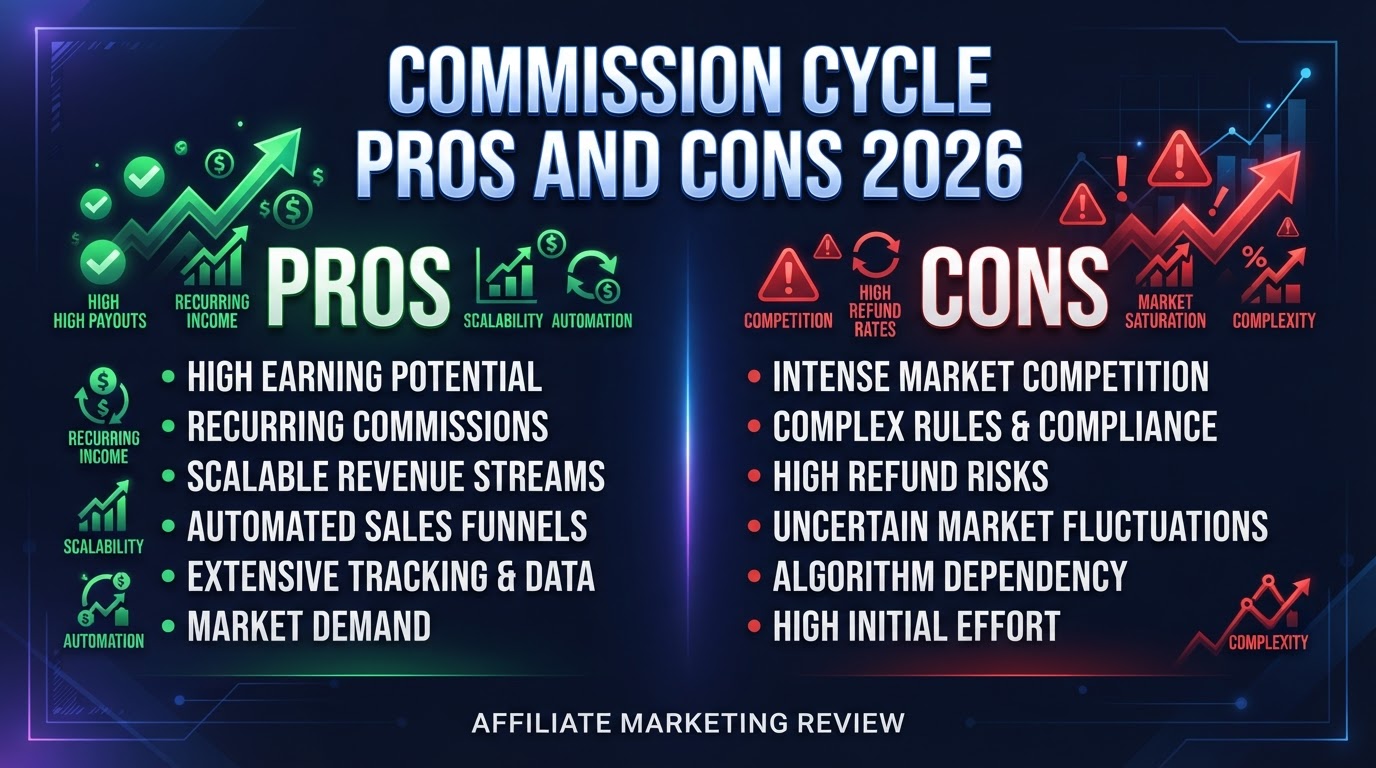
- Structured affiliate marketing system that connects all the pieces
- Reinvestment model focused on scaling, not just one-off commissions
- Multiple traffic sources: Instagram, YouTube, social, email, organic
- Instagram is accessible for beginners without a big budget
- YouTube provides long-term, evergreen traffic potential
- AI-assisted tools can speed up research, scripts, and content
- Strategy can be adapted to niches beyond personal development
- Can be used to build an owned audience (subscribers, followers, list)
- High-ticket affiliate commissions (up to $1,200+ per sale)
- Payment plan available to lower the upfront cost
Cons & Drawbacks
- $2,497 is a substantial investment for most buyers
- Payment plan costs $485 more overall ($2,982 total)
- No guaranteed income — training doesn't guarantee results
- You still have to generate your own traffic
- Content creation takes consistent time and effort
- Additional business expenses (tools, hosting, ads) may apply
- Results can take months and vary significantly between students
- High-ticket affiliate marketing requires trust and authority
- Promotional claims should be viewed as marketing, not guarantees
- Affiliate promotion rules are specific and must be followed
Affiliate Disclosure: This article may contain affiliate links. If you purchase through a link on this page, we may earn a commission at no additional cost to you. This does not change the information or opinions presented in this article.
If you're considering joining Commission Cycle, you've probably already seen the marketing around its affiliate marketing system, traffic strategies, AI-assisted tools, and potential commissions. But before spending $2,497, it's worth looking at both sides of the offer.
What are the advantages? What are the disadvantages? Is the training suitable for beginners? And perhaps most importantly: Are the potential benefits worth the investment? This guide takes an objective look at the Commission Cycle pros and cons in 2026 so you can make a more informed decision.
Commission Cycle Pros and Cons at a Glance
Here's the quick version.
Pros
- Structured affiliate marketing system
- Focus on traffic generation
- Instagram and YouTube strategies
- AI-assisted content tools
- Lead-generation strategies
- Reinvestment and scaling model
- High-ticket affiliate opportunity
- Multiple content angles
- Payment plan available
- Potential to build an owned audience
Cons
- $2,497 is a significant investment
- Payment plan costs more overall
- No guaranteed income
- Requires consistent implementation
- Traffic isn't automatic
- Content creation takes time
- Additional business expenses may apply
- Results can vary significantly
- Some promotional claims should be viewed as marketing claims rather than guarantees
Let's look at each point in more detail.
Weighing up Commission Cycle for yourself?
Review the official offer, pricing, and full program details before you decide.
Check the Official Offer →What Is Commission Cycle?
Commission Cycle is an affiliate marketing training program built around a system for generating affiliate commissions and reinvesting part of those commissions into the business. According to the official materials, the method focuses on four business levers: Leads, Conversions, Average dollars per sale, and Average number of sales per customer. The idea is to identify which lever is currently the most economical to improve and reinvest some of the profits into that area.
The training also covers traffic strategies and focuses initially on the personal-development niche, while also covering the make-money-online niche.
Commission Cycle Pricing
Before looking at the pros and cons, it's important to understand the investment. The current official offer lists Commission Cycle at $2,497, with an installment option of 6 × $497. That means 6 × $497 = $2,982, so the payment plan costs $485 more than paying upfront.
| Pay in full | $2,497 |
| 6-payment plan | 6 × $497 |
| Payment-plan total | $2,982 |
| Difference | $485 |
The current official affiliate page confirms these prices.
Commission Cycle Pros
1. It Provides a Structured Affiliate Marketing System
One of the biggest advantages of a comprehensive program is structure. Affiliate marketing can become overwhelming because there are so many individual components: finding offers, creating content, generating traffic, building an audience, capturing leads, following up, converting prospects, and scaling. Commission Cycle attempts to connect these pieces into one system. The central model is essentially: Traffic → Leads → Sales → Commissions → Reinvestment → Growth. That can be easier to follow than learning disconnected tactics from dozens of different sources.
2. The Commission Cycle Model Is Focused on Reinvestment
The central concept isn't simply "make a commission." It's about what happens after you make the commission. According to the official explanation, part of each commission can be reinvested into whichever of the four major profit levers is cheapest to improve at that point. For example, suppose you're getting traffic but your conversion rate is poor — instead of simply buying more traffic, the model would encourage you to determine whether improving conversions is a better use of the money. That's a useful business principle.
3. It Covers Multiple Traffic Sources
Another advantage is that Commission Cycle doesn't appear to rely on just one traffic source. The 2026 launch materials include strategies involving Instagram, YouTube, social content, email, lead generation, and organic assets. The official promotional material specifically notes that social posts and short videos can be used to drive people toward live sessions or replay windows. Having multiple potential traffic channels can reduce dependence on a single platform.
4. Instagram Can Be Useful for Beginners
Instagram provides an accessible way to start creating content. You don't necessarily need a large website, a huge email list, or a massive advertising budget to begin publishing. The launch materials provide social-media promotional resources and specifically mention Instagram content among the available affiliate materials. For someone who enjoys short-form content, this could be an attractive part of the strategy.
5. YouTube Provides Long-Term Traffic Potential
YouTube can be particularly valuable because videos can continue generating views after publication. A useful video can potentially attract traffic today, next week, next month, or months later. That makes YouTube different from some short-lived social posts. The launch materials also emphasize social and video-based promotion, making YouTube a potentially useful channel for implementing the broader approach.
6. AI Can Speed Up Content Creation
Another potential advantage is the use of AI-assisted tools. The promotional materials describe tools and resources designed to help with research, scripts, social posts, videos, and images. For someone producing content regularly, AI assistance could reduce the time required for certain tasks. However, AI doesn't eliminate the need for strategy — you still need to create useful content that people actually want to consume.
See what's included in the official offer
Confirm current pricing, tools, and program details before joining.
View Official Offer →7. The Strategy Can Be Applied to Different Niches
Commission Cycle's training leads with personal development and also covers the make-money-online niche. The official materials state that students can use niches outside those areas as well. That gives marketers some flexibility. For example, the underlying affiliate marketing process could potentially be adapted to areas such as software, fitness, personal development, finance, online education, business, technology, or hobbies. The exact suitability will depend on the offer and traffic strategy.
8. It Can Be Used to Build an Audience
One of the strongest aspects of content-based affiliate marketing is that you're not necessarily relying entirely on paid advertisements. You can build YouTube subscribers, Instagram followers, email subscribers, community members, and website visitors. Over time, these can become valuable business assets. The launch materials specifically discuss list growth and audience engagement as part of the broader model.
9. High-Ticket Commissions Can Be Attractive
Commission Cycle currently sells for $2,497. The official affiliate materials state that affiliates receive 50% commission after transaction fees, with potential payouts of up to $1,200+ per sale. From an affiliate's perspective, a higher-ticket offer means you don't necessarily need hundreds of sales to generate meaningful revenue. However, there's an important caveat: higher commission doesn't necessarily mean easier sales. High-ticket products typically require more trust and a stronger sales process.
10. A Payment Plan Is Available
Not everyone can comfortably pay $2,497 upfront. The current offer includes 6 × $497, which lowers the initial payment requirement. The trade-off is that the total cost is higher. So this is an advantage from a cash-flow perspective, but not from a total-cost perspective.
Commission Cycle Cons
Now let's look at the other side. These are the factors prospective buyers should take particularly seriously.
1. The $2,497 Price Is High
This is probably the biggest disadvantage. $2,497 is a substantial investment. There are countless free affiliate marketing resources available online, and there are also much cheaper courses. So why pay $2,497? The answer has to be: you're paying for the structured system, tools, methodology and implementation guidance — not simply information about affiliate marketing. If you don't value those components enough to justify the price, Commission Cycle may not be the right investment.
2. The Payment Plan Costs More
The installment option is 6 × $497 = $2,982. That's $485 more than the $2,497 one-time price. So while installments make the initial purchase easier, they increase the total cost. Always consider the total amount, not just the monthly payment.
3. There Is No Guaranteed Income
This is extremely important. Commission Cycle can provide training, strategies, tools, frameworks, and resources — but it cannot guarantee your personal results. Your results can depend on traffic, content, audience, niche, conversion rate, offer selection, consistency, and implementation. Someone can follow the same training as another person and get completely different results.
4. You Still Have to Generate Traffic
Buying the training doesn't automatically give you an audience. You still need to create traffic. That could involve YouTube, Instagram, email, SEO, paid advertising, social media, or communities. Traffic generation takes work, and building organic traffic can take months.
5. Content Creation Takes Time
If you're using Instagram and YouTube, you're going to need content. That means: Research → Create → Edit → Publish → Analyze → Improve. AI can make some of those steps faster, but it doesn't eliminate the work entirely. If you don't enjoy content creation, this may become one of the biggest challenges.
Still deciding if Commission Cycle is right for you?
Review the official offer and confirm current terms before making your decision.
Check the Official Offer →6. Additional Expenses May Apply
The $2,497 price shouldn't necessarily be considered the total cost of running your affiliate business. You may also need a domain, website hosting, email software, design tools, video tools, AI subscriptions, automation software, and an advertising budget. Your actual business investment could therefore be higher than the Commission Cycle purchase price.
7. Results Can Take Time
Affiliate marketing isn't necessarily an overnight business. You may need to choose a niche, research offers, create content, build traffic, capture leads, test messaging, improve conversions, and build an audience. That takes time. If you're expecting your first commission immediately, you may become disappointed.
8. High-Ticket Affiliate Marketing Requires Trust
Promoting a $20 product and promoting a $2,497 product are very different experiences. A potential customer may be comfortable purchasing a $20 tool without much research. A $2,497 purchase requires much more consideration. You may therefore need to build authority, trust, social proof, useful content, email relationships, and personal credibility. This can make the sales process more challenging.
9. Promotional Claims Need Context
The official affiliate page says that its previous four September launches generated more than $21 million in combined sales and advertises potential commissions of up to $1,200+ per sale. These figures come from the program's own promotional materials. That doesn't necessarily mean they're false — but they should be understood as company-reported promotional claims, not a guarantee of what an individual student or affiliate will earn. That's an important distinction when evaluating any online business opportunity.
10. The Affiliate Rules Are Fairly Specific
If you're considering promoting Commission Cycle yourself, you'll want to read the affiliate rules carefully. The official terms include restrictions around negative marketing, PPC, order-page links, public replay links, brand-related domains, self-purchases, review sites, and promotion methods. The official affiliate page also states that affiliates may be reviewed for their promotional method and may need to provide evidence of how they're driving traffic. This isn't necessarily a negative — in fact, clear affiliate rules can be a positive sign. But it means you shouldn't promote the offer however you want.
Commission Cycle Pros and Cons Comparison
| Feature | Pros | Cons |
|---|---|---|
| Training | Structured system | Premium price |
| Traffic | Multiple strategies | Traffic still requires work |
| Accessible content platform | Requires consistent posting | |
| YouTube | Long-term traffic potential | Videos take time |
| AI tools | Can speed up content | AI doesn't guarantee results |
| Affiliate commissions | Potentially high payouts | Sales aren't guaranteed |
| Payment plan | Lower upfront cost | Higher total cost |
| Scaling | Reinvestment model | Requires capital and testing |
| Niches | Can adapt beyond core niches | Some niches may be harder |
| Automation | Can reduce repetitive work | May require additional tools |
| Beginner-friendly | Structured roadmap | $2,497 is substantial for beginners |
Commission Cycle Pros and Cons for Beginners
If you're completely new to affiliate marketing, the biggest advantage may be structure. Instead of trying to figure everything out yourself, you have a defined methodology. But the biggest disadvantage is the price. My recommendation for beginners: don't ask only "Can I afford $2,497?" — ask "Can I afford $2,497 and still comfortably fund the rest of my business?" You don't want to spend your entire available budget on training and then have nothing left for your website, tools or content.
Commission Cycle Pros and Cons for Experienced Marketers
Experienced affiliate marketers may see a different value proposition. If you already know SEO, email marketing, funnels, paid traffic, social media, and copywriting, then basic affiliate marketing lessons may not be the main reason to join. Instead, you should evaluate: Is the Commission Cycle methodology new to you? Are the traffic strategies useful? Will the tools save you time? Does the reinvestment model improve your current business? Does the training fill a gap in your existing strategy? If the answer is yes, the program could potentially offer more value.
Is Commission Cycle Worth the Price?
This depends on what you're trying to accomplish.
It may be worth considering if you are serious about affiliate marketing, want a structured system, are willing to create content, want to use Instagram or YouTube, have the budget, understand that results aren't guaranteed, and are willing to implement the training.
It may not be right if you need guaranteed income, have very limited funds, don't want to create content, don't have time to implement, expect instant results, or are uncomfortable with a $2,497 investment.
My Honest Assessment of Commission Cycle
After looking at the current official information, I see both legitimate advantages and important limitations. The strongest advantage: the program provides a defined framework rather than simply throwing affiliate marketing information at you. The Commission Cycle model — leads × conversions × average sale value × customer value, combined with reinvestment — is a straightforward way of thinking about scaling. The biggest disadvantage: the price. At $2,497, you need to be serious about implementation for the investment to make sense. And even then, there are no guaranteed results.
Want to see the current offer?
Review official pricing, payment plans, and full program details.
Check the Official Commission Cycle Offer →Final Verdict: Commission Cycle Pros and Cons
So, is Commission Cycle worth considering? Yes — but it's not for everyone. The pros include structured affiliate marketing training, multiple traffic strategies, Instagram and YouTube opportunities, AI-assisted content tools, lead generation, automation, a reinvestment methodology, and potentially high affiliate commissions. The cons include the $2,497 price, a more expensive installment option, no guaranteed income, required traffic generation, required content creation, potential additional expenses, and results that depend heavily on implementation.
The most important takeaway is this: Commission Cycle should be evaluated as an education and business-building investment, not as a guaranteed income opportunity. If you have the budget, understand the risks and are prepared to put in the work, it may be worth investigating. If $2,497 would put you under financial pressure, there's no reason to rush.
Frequently Asked Questions
Quick answers to the most common questions about Commission Cycle.
Related Guides
Continue your research with these detailed guides.
Ready to learn more?
Review the official training, current pricing, and offer details before making your decision.
Check the Official Offer