How to Build an Online Profit Machine in 2026: A Practical Step-by-Step Guide
Learn how to build an online profit machine in 2026 using affiliate marketing, content, AI tools, automation, traffic, and a repeatable sales system.

Key Takeaways
- An online profit machine is a repeatable system — not a one-time sale — connecting audience, offer, traffic, conversion, measurement, and reinvestment.
- The five core stages are: choose a market, choose an offer, build a traffic engine, convert attention into customers, and measure, improve, and reinvest.
- Affiliate marketing lets you start without creating a product; digital products give you more control later.
- AI accelerates research, content, scripts, images, and automation — but strategy and human review remain essential.
- The Commission Cycle model uses four levers (leads, conversions, average $ per sale, repeat purchases) and reinvests into the most economical one.
Pros & Highlights
- Repeatable framework that turns attention into a self-sustaining revenue cycle
- Works with affiliate marketing, digital products, or services
- AI and automation reduce repetitive production work
- Multiple traffic channels (YouTube, Instagram, SEO, email, paid)
- Reinvestment model compounds growth over time
Cons & Drawbacks
- No guaranteed income — results depend on implementation and market factors
- Requires consistent content creation and audience engagement
- Building organic traffic takes time
- Additional tools and software may be needed
- Not truly passive — ongoing management is required
Affiliate Disclosure: This article may contain affiliate links. If you purchase a product through an affiliate link on this page, I may receive a commission at no additional cost to you. This content is intended for informational and educational purposes. Online business results vary, and no specific income or business outcome is guaranteed.
Building an online business in 2026 doesn't necessarily require a large team, expensive office, or your own physical products. Today, one person can combine content, affiliate marketing, AI tools, automation, social media, digital products, and email marketing to create a system that attracts potential customers and generates sales.
But there's an important distinction between making an occasional online sale and building an actual business system. An online profit machine is designed to make the process repeatable.
Instead of asking: "How can I make money online today?" the better question is: "How can I build a system that consistently turns attention into leads, leads into customers, and customers into additional revenue?"
That's the concept behind several modern online-business strategies, including the framework discussed in the Commission Cycle ecosystem. In this guide, we'll break down how to build an online profit machine in 2026, including the five major components you need, how AI can help, how affiliate marketing fits into the model, and how to turn individual sales into a repeatable growth system.
Build Your Online Profit Machine
Explore the Commission Cycle system and official training resources.
Explore Official Resources →What Is an Online Profit Machine?
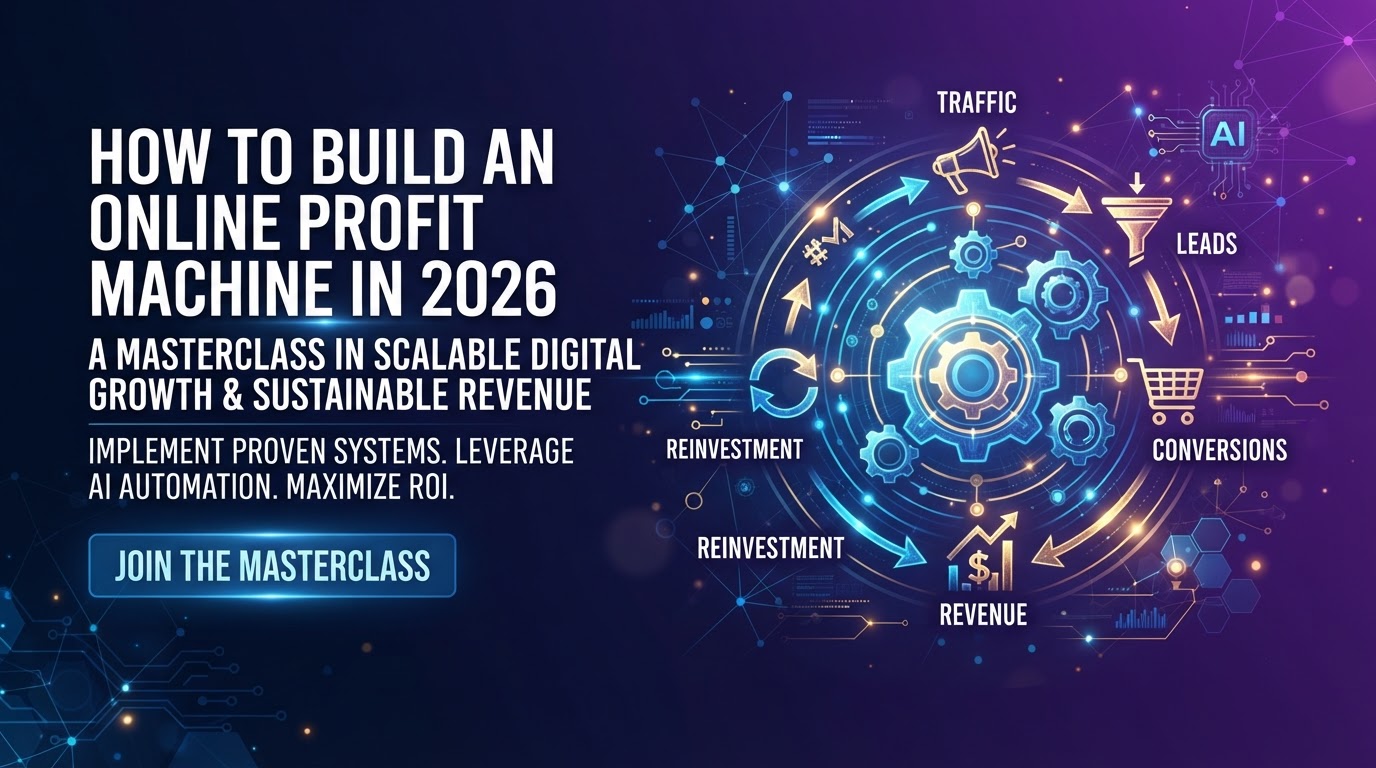
An online profit machine is a collection of connected marketing and sales processes designed to consistently generate revenue. A simplified version looks like this: Traffic → Engagement → Leads → Conversions → Revenue → Reinvestment → More Traffic.
The goal isn't necessarily to make every part completely automated. Instead, the objective is to create a system where each component supports the next one. For example: you publish useful content, people discover the content, some people engage with it, interested users become leads or start conversations, some leads purchase an offer, you earn revenue, part of that revenue is reinvested into marketing, and the improved system generates more opportunities. That creates a cycle rather than a one-time transaction.
The 5 Core Steps to Build an Online Profit Machine
The exact implementation can vary by business model, but a practical system can be built around five major stages:
- Step 1: Choose a Profitable Market and Problem
- Step 2: Create an Offer
- Step 3: Build a Traffic Engine
- Step 4: Convert Attention Into Customers
- Step 5: Measure, Improve, and Reinvest
Let's examine each one.
Step 1: Choose a Market With a Real Problem
Before building websites, funnels, social media accounts, or AI workflows, choose who you want to help and what problem you want to solve. This is one of the most important parts of an online business.
A useful market generally has a specific audience, a recognizable problem, existing demand, products or services people already purchase, and places where the audience can be reached. For example, instead of targeting "everyone who wants to make money," you could focus on "beginners who want to learn affiliate marketing using social media."
How to Find a Good Market
Start with three questions:
- What does this audience want? More customers, more income, better productivity, weight-management information, business growth, better marketing, or time savings.
- What problem is stopping them? Lack of knowledge, lack of traffic, lack of time, poor conversion rates, difficulty creating content, or expensive tools.
- Are they already spending money to solve it? Existing spending can indicate that products, services, software, courses, or other solutions already exist around the problem.
Ready to build your profit machine?
Access the official Commission Cycle training and resources.
Access Official Training →Step 2: Choose an Offer
Once you know your audience and problem, you need something relevant to offer. There are several ways to do this.
Option 1: Affiliate Marketing
With affiliate marketing, you promote another company's product or service and receive a commission when qualifying sales occur. The basic model is: Content → Visitor → Affiliate Offer → Sale → Commission. This can be attractive for beginners because you don't necessarily need to create your own product. You can focus on traffic, content, audience building, promotion, and conversions. The Commission Cycle training, for example, focuses heavily on affiliate profits and traffic strategies, particularly around social content and online marketing.
Option 2: Create a Digital Product
Another option is creating your own product. Examples include ebooks, courses, templates, checklists, prompt libraries, tutorials, memberships, software, and digital guides. The advantage is that you control the product and customer experience. The disadvantage is that you have to create and maintain the product.
Option 3: Sell a Service
You can also turn your expertise into a service. Examples include SEO, web design, marketing, video editing, AI automation, copywriting, consulting, and social media management. A service business can generate revenue without requiring you to build a large audience first.
Step 3: Build a Traffic Engine
An online profit machine needs people. No traffic means no conversations, leads, or customers. In 2026, there are many potential traffic sources.
Organic Search
You can create articles targeting questions people search for. For example: "How does affiliate marketing work?", "Best AI tools for small businesses", "How to create a digital product", or "How to get more leads online."
YouTube
YouTube can be used for tutorials, reviews, comparisons, educational videos, product demonstrations, and case studies. A single useful video can potentially continue attracting viewers after publication.
Instagram can be used for short-form videos, carousels, educational posts, stories, comments, and direct conversations. The Commission Cycle launch materials specifically identify Instagram and YouTube as important traffic sources for its model.
Email Marketing
An email list gives you a direct communication channel with people who have opted in. A simple system could be: Free Resource → Email Opt-In → Educational Emails → Relevant Offer. You don't necessarily need thousands of subscribers. A smaller, engaged audience can be valuable if the content and offers are relevant.
Paid Advertising
Paid traffic can accelerate testing. Potential channels include Google Ads, Meta Ads, YouTube Ads, and other advertising platforms. However, paid traffic requires careful tracking. You should know how much you are spending and how much revenue that traffic is generating.
Turn Traffic Into a Repeatable System
Learn the Commission Cycle reinvestment model from the official training.
Learn the Commission Cycle →Step 4: Turn Attention Into Leads and Customers
Getting traffic is only part of the equation. You also need a conversion process. A simple online profit machine might look like: Content → Call to Action → Landing Page → Lead Capture → Email/SMS/Conversation → Offer → Purchase → Follow-Up. The exact structure depends on the business.
The Importance of Conversations
One interesting approach highlighted in Commission Cycle's training is using social-media interactions as the starting point for conversations. The first Profit Engine Live session was titled "How to Get Paid from 1 Word Replies (Commission Cycle Method Revealed)." The concept is essentially that a simple interaction can become the beginning of a deeper conversation. For example: Post → Comment → Reply → Conversation → Recommendation. This can be especially useful for social platforms where comments and direct messages are a major part of audience interaction. The important point is that the conversation should be relevant and useful rather than simply turning every comment into a sales pitch.
Step 5: Measure, Improve, and Reinvest
This is where a collection of marketing activities becomes a business system. You should track the performance of each major component.
| Metric | Question |
|---|---|
| Traffic | How many people are visiting? |
| Engagement | Are people interacting? |
| Leads | How many people are interested? |
| Conversion Rate | How many leads become customers? |
| Revenue | How much money is generated? |
| Average Order Value | How much is each customer worth? |
| Repeat Purchases | Do customers buy again? |
| Acquisition Cost | How much does it cost to acquire a customer? |
Once you have data, you can identify where improvements could have the greatest effect.
The Commission Cycle Concept
The Commission Cycle model describes profit using four major levers: Leads × Conversions × Average $ Per Sale × Average Number of Sales Per Customer. The concept is that these variables work together rather than independently.
For example, imagine a simplified business: 1,000 leads, 3% conversion rate, $100 average sale, 1 purchase per customer. That would produce: 1,000 × 3% × $100 × 1 = $3,000. Now imagine improving one variable. If the conversion rate increases from 3% to 4%, the same number of leads would produce: 1,000 × 4% × $100 = $4,000. You didn't necessarily need another 1,000 leads. You improved another part of the system.
Why Reinvestment Matters
Once an online business begins generating revenue, the next question is: what should you do with the profit? One approach is to reinvest some of it into the part of the system that has the clearest opportunity for improvement.
- If traffic is the problem: Invest in content, SEO, advertising, or partnerships.
- If conversions are the problem: Improve landing pages, sales copy, offers, follow-up, or calls to action.
- If average order value is low: Consider bundles, upsells, higher-value products, or complementary products.
- If repeat purchases are low: Improve follow-up, email marketing, customer experience, or related offers.
This is the basic idea behind creating a cycle.
Apply the Commission Cycle Model
Learn how to identify and reinvest into your most economical growth lever.
Apply the Model →How AI Can Help Build an Online Profit Machine
AI has become one of the most useful additions to online marketing workflows. It can assist with many repetitive tasks.
AI for Market Research
AI can help you organize customer problems, competitor messaging, content ideas, search questions, product ideas, and audience characteristics. You still need to verify important information, but AI can speed up the research process.
AI for Content Creation
You can use AI to help develop blog outlines, social posts, video scripts, email drafts, headlines, FAQs, and product descriptions. Commission Cycle's official affiliate materials describe AI tools being used for research, social posts, scripts, videos, and images.
AI for Video Marketing
You can create a repeatable video workflow: Topic → Research → Script → Voiceover → Visuals → Editing → Upload. For example, one article could potentially become one YouTube video, five short-form videos, three social posts, one email, and several image posts. This is called content repurposing.
AI for Customer Communication
AI can also assist with chat, FAQ responses, lead qualification, follow-up, appointment booking, and customer support. The objective isn't necessarily to replace human interaction. Instead, automation can handle repetitive questions while humans focus on more complicated conversations.
Build a Simple One-Person Profit Machine
You don't need to launch everything at once. A beginner-friendly system might look like this:
- Stage 1: Choose one niche.
- Stage 2: Choose one offer.
- Stage 3: Choose one traffic channel.
- Stage 4: Create a simple landing page.
- Stage 5: Create useful content consistently.
- Stage 6: Capture leads or start conversations.
- Stage 7: Recommend the offer.
- Stage 8: Track conversions.
- Stage 9: Improve the weakest part.
- Stage 10: Reinvest and repeat.
This is much easier to manage than trying to build a huge business immediately.
Example: Building an Affiliate Profit Machine
Let's use a hypothetical example. Suppose you choose the personal development niche. You could build: YouTube Channel → Educational videos → Free guide → Email list → Affiliate recommendations → Commission → Reinvest into content → More traffic. The official Commission Cycle materials identify personal development and make-money-online as two primary niches used in its training. The important thing is that the example doesn't depend on one particular product. The same architecture can potentially be adapted to many legitimate niches.
Example: Building a Digital Product Profit Machine
Suppose you have expertise in productivity. You could create: Free productivity checklist → Email opt-in → Educational emails → $19 digital guide → $49 template bundle → $97 advanced course. This creates a simple product ladder. You don't necessarily need to launch everything on day one. Start with one useful product and improve the system based on customer feedback.
Example: Using Content to Drive the Machine
Let's say you publish one long-form YouTube video. You can turn that into 5 Shorts, 3 Instagram posts, 1 email, 1 blog article, 5 quote graphics, and several community posts. Now one piece of research can support multiple marketing assets. This is where AI-assisted workflows can become valuable.
Common Mistakes to Avoid
Mistake #1: Trying Everything at Once
Don't start with YouTube, TikTok, Instagram, SEO, Facebook, Pinterest, paid ads, email, and podcasting all at the same time. Start with one primary traffic source.
Mistake #2: Choosing an Offer Before Choosing an Audience
Instead of asking "What product should I promote?", start with "Who am I trying to help?" Then find a relevant offer.
Mistake #3: Focusing Only on Traffic
More traffic isn't always the answer. If 10,000 visitors produce no customers, getting another 10,000 visitors may not solve the underlying problem. Look at the entire funnel.
Mistake #4: Believing AI Does Everything
AI can accelerate research and production. It doesn't automatically create product-market fit, trust, demand, customer relationships, or good strategy. Human oversight still matters.
Mistake #5: Expecting Instant Results
Building a business system usually requires testing. You may need to test headlines, content topics, offers, landing pages, calls to action, traffic sources, and follow-up sequences. Treat the process as experimentation rather than expecting the first version to be perfect.
How Long Does It Take to Build an Online Profit Machine?
There isn't a universal timeline. It depends on your existing audience, skills, niche, offer, traffic source, available time, budget, and consistency. Someone who already has an audience can potentially move faster than someone starting from zero. A better objective is to build the system in stages.
- Month 1: Focus on market, offer, content, and basic funnel.
- Month 2: Focus on traffic, leads, conversations, and conversion testing.
- Month 3: Focus on optimization, automation, repurposing, and reinvestment.
These aren't guaranteed milestones or income expectations — they're simply an example of how the work can be organized.
Should You Use Affiliate Marketing or Your Own Product?
You don't necessarily have to choose permanently. You could start with affiliate marketing and later create your own product. For example: Phase 1 — promote relevant affiliate products; Phase 2 — build an audience; Phase 3 — identify recurring customer problems; Phase 4 — create your own solution; Phase 5 — add your product alongside affiliate offers. This can gradually give you more control over your revenue model.
What About the "5 Steps to an Online Profit Machine" Training?
The phrase "5 Steps to an Online Profit Machine" was used as the title of a September 19, 2026 Profit Engine Live 2 session associated with the Commission Cycle launch. The official affiliate materials list that session for September 19 at 3 PM Eastern. The same official materials state that Profit Engine Live 2 was live-only and had no replay, so readers should not assume that an old replay link exists for this session. If you're researching the broader Commission Cycle system, the official launch page is the appropriate place to check the current event and registration information.
Is an Online Profit Machine Really Passive Income?
Not necessarily. This distinction is important. An online profit machine can include automation, but automation doesn't mean there is no work involved. You may still need to create content, monitor campaigns, answer customers, test offers, update websites, analyze data, manage expenses, and improve products. The goal is leverage, not necessarily zero work. Automation can help you accomplish more with the same amount of time.
A Simple Online Profit Machine Blueprint
Here's the complete framework: Audience → Useful Content → Traffic → Comments/Leads → Conversations/Follow-up → Offer → Sales → Profit → Reinvestment → More Traffic → More Sales. That's the basic idea. You aren't simply trying to make one sale. You're building a process that can repeatedly produce opportunities.
Your 30-Day Online Profit Machine Action Plan
If you're starting from scratch, here's a practical 30-day roadmap.
Days 1–5: Research
Choose one audience, one problem, one niche, and one offer. Research what your audience is already searching for and discussing.
Days 6–10: Build the Foundation
Create a website or landing page, lead capture form, basic thank-you page, primary call to action, and analytics/tracking. Keep it simple.
Days 11–20: Create Content
Publish consistently. For example: 3–5 short-form posts per week, 1–2 long-form videos, several useful social posts, and 1–2 SEO articles. Focus on solving problems rather than constantly pitching.
Days 21–25: Start Conversations
Respond to comments, questions, messages, and email replies. Identify people who have genuine interest.
Days 26–30: Analyze
Review traffic, engagement, leads, click-through rate, conversions, and revenue. Then ask: what is the biggest bottleneck? That's what you should work on next.
Start Building Your Online Profit Machine
Access the official Commission Cycle training and reinvestment framework.
Access Official Training →Final Thoughts: How to Build an Online Profit Machine in 2026
Building an online profit machine isn't about finding one magical website, tool, or strategy. It's about connecting several basic business components: Audience + Offer + Traffic + Conversion + Measurement + Reinvestment.
AI can make many parts faster. Automation can reduce repetitive work. Affiliate marketing can eliminate the need to create a product. Digital products can give you more control over what you sell. Content can bring in organic attention. Email and conversations can help nurture interested people. But none of these components works independently. The real opportunity is in connecting them.
If you're researching the Commission Cycle approach specifically, its official materials describe a model built around four profit levers — leads, conversions, average revenue per sale, and repeat purchases — and a reinvestment cycle intended to improve whichever lever presents the clearest opportunity.
The best way to approach an online profit machine is therefore not "How can I make money as quickly as possible?" Instead, think: "How can I build a repeatable system that creates value, attracts the right people, converts relevant offers, measures the results, and improves over time?" That's a much more sustainable way to think about building an online business in 2026.
Frequently Asked Questions
Quick answers to the most common questions about Commission Cycle.
Related Guides
Continue your research with these detailed guides.
Ready to learn more?
Review the official training, current pricing, and offer details before making your decision.
Check the Official Offer