Mark Ling's 5 Steps to an Online Profit Machine: Training Overview
Explore Mark Ling's 5 Steps to an Online Profit Machine training, including the core concepts, affiliate marketing strategies, AI tools, and who it's for.

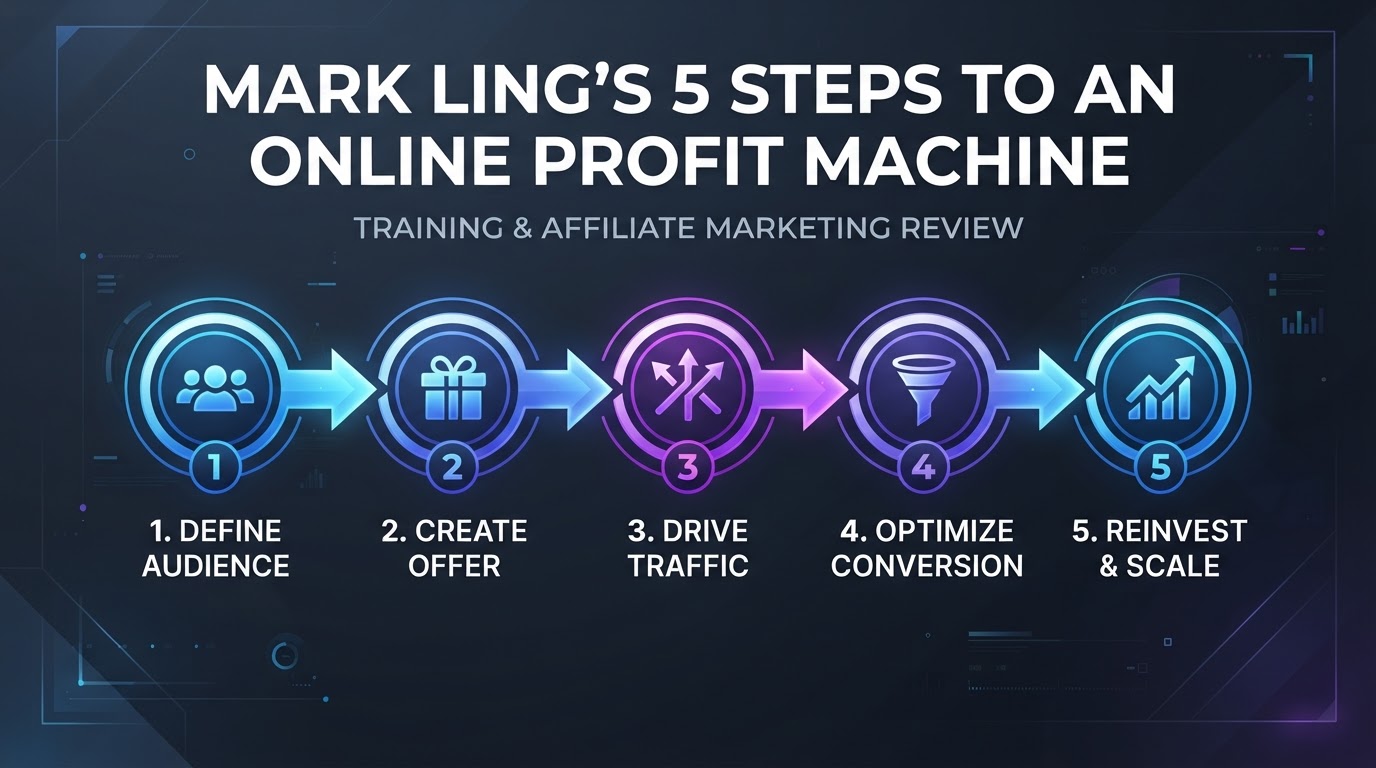
Key Takeaways
- The 5 Steps to an Online Profit Machine concept connects audience, offer, traffic, conversion, and optimization into a repeatable business system.
- It ties into the Commission Cycle four-lever model: leads, conversions, average dollars per sale, and repeat purchases.
- Affiliate marketing lets you start without creating a product; digital products give you more control later.
- AI accelerates research, content, scripts, images, and automation — but strategy and human review remain essential.
- An online profit machine is leveraged, not passive — ongoing management, testing, and optimization are still required.
Pros & Highlights
- Structured five-step framework that organizes online business into measurable stages
- Works with affiliate marketing, digital products, or services
- AI and automation reduce repetitive production work
- Multiple traffic channels (Google, YouTube, Instagram, email, paid)
- Reinvestment model compounds growth over time
Cons & Drawbacks
- No guaranteed income — results depend on implementation and market factors
- Requires consistent content creation and audience engagement
- Building organic traffic takes time
- Additional tools and software may be needed
- Not truly passive — ongoing management is required
Affiliate Disclosure: This article may contain affiliate links. If you purchase through an affiliate link on this page, I may receive a commission at no additional cost to you. This content is intended for informational and educational purposes. Online business results vary, and no specific income or business outcome is guaranteed.
If you've been researching affiliate marketing, online business, AI automation, or ways to build a digital income stream in 2026, you may have come across Mark Ling's "5 Steps to an Online Profit Machine" training.
The concept is built around a straightforward question: How can you turn an online marketing process into a repeatable system rather than relying on individual sales?
The training is associated with the Commission Cycle and Profit Engine Live ecosystem and focuses on areas such as traffic, engagement, conversions, affiliate marketing, AI tools, automation, and digital products. But what exactly does the "5 Steps to an Online Profit Machine" concept involve? In this guide, we'll provide a detailed overview of the training, explain the business concepts behind it, discuss the role of AI and automation, look at how affiliate marketing fits into the model, and explain what beginners should understand before getting started.
Explore the Online Profit Machine Training
Access the official Commission Cycle and Profit Engine Live training resources.
Explore Official Resources →Who Is Mark Ling?
Mark Ling is an online marketer known for his work in affiliate marketing and internet entrepreneurship. His training materials have focused on areas including affiliate marketing, online traffic, digital products, sales funnels, email marketing, social media, online business systems, and automation. The "5 Steps to an Online Profit Machine" concept is connected to the broader Commission Cycle/Profit Engine Live training ecosystem.
What Is "5 Steps to an Online Profit Machine"?
5 Steps to an Online Profit Machine is a training concept designed to explain how an online business can be structured around a repeatable profit-generating process. Rather than looking at an online business as simply "create a website → put up an offer → wait for sales," the approach looks at the different components responsible for generating revenue.
A simplified model is: Audience → Traffic → Engagement → Conversion → Revenue → Optimization. The idea is to create a system where each component can be measured and improved.
The Connection to Commission Cycle
The training concept fits into the broader Commission Cycle model. Commission Cycle describes four major business levers: leads, conversions, average dollars per sale, and average number of sales per customer. These variables can work together to determine overall revenue.
For example, imagine a hypothetical business with 1,000 leads, 3% conversion, $100 average sale, and 1 purchase per customer. The simplified calculation would be: 1,000 × 3% × $100 = $3,000. If the business improves conversion from 3% to 4%, the same 1,000 leads would produce: 1,000 × 4% × $100 = $4,000. The example demonstrates an important principle: growing revenue doesn't always mean getting more traffic. Sometimes improving conversion or increasing customer value can have a significant effect. The official Commission Cycle materials describe this type of four-lever model and a reinvestment approach around improving different parts of the business.
What Are the Five Steps?
The exact training presentation can vary by event or version, so it's important not to treat a general framework as a verbatim transcript of every training session. At a practical level, the online profit-machine concept can be understood through five connected stages:
- Step 1: Find the Right Market
- Step 2: Create or Select the Right Offer
- Step 3: Generate Targeted Traffic
- Step 4: Convert Attention Into Sales
- Step 5: Optimize and Reinvest
Let's break each one down.
Step 1: Find the Right Market
The first step is understanding who you want to reach. A common mistake among beginners is starting with a product. They find an interesting affiliate offer and immediately ask: "How can I sell this?" A more useful approach is to begin with the audience. Ask: Who has the problem? What are they trying to accomplish? What information are they searching for? What products are they already buying? Where do they spend time online? What type of content gets their attention?
Choose a Specific Problem
A market becomes easier to target when you can identify a specific problem. For example, instead of "people interested in business," you might focus on "beginners who want to start affiliate marketing without creating their own products." Instead of "people interested in AI," you could target "small business owners who want to automate customer communication with AI." The narrower starting point makes content and offers easier to align.
Find the Right Market Faster
Learn the audience-first approach from the official training.
Access Official Training →Step 2: Create or Select the Right Offer
Once you've identified an audience, you need something relevant to offer. There are three common options.
Affiliate Products
You promote another company's product and receive a commission on qualifying sales. This can be an attractive model because you don't have to develop the product yourself. Your focus can instead be content, traffic, audience, promotion, and conversion.
Your Own Digital Product
You can create courses, ebooks, templates, guides, software, memberships, or checklists. This gives you greater control over the product and customer experience.
Services
You can also monetize expertise through services such as consulting, marketing, SEO, web design, AI automation, copywriting, or lead generation. The right model depends on your skills, resources, and target audience.
Step 3: Generate Targeted Traffic
A profit machine needs traffic. But the objective isn't necessarily to generate the largest possible amount of traffic. It's to generate traffic from people who are relevant to your offer. Potential traffic channels include:
- Google Search: Create useful content around questions and problems your target audience searches for.
- YouTube: Create tutorials, reviews, comparisons, case studies, educational videos, and demonstrations. YouTube can also serve as a search engine, allowing useful videos to continue attracting viewers over time.
- Instagram: Instagram can support short videos, carousels, educational posts, stories, comments, and direct conversations. The official Commission Cycle materials specifically discuss Instagram and YouTube as traffic sources within its broader model.
- Email: Email can help turn one-time visitors into an ongoing audience. A simple process might be: Content → Free Resource → Email Subscriber → Helpful Emails → Relevant Offer.
- Paid Advertising: Advertising can provide faster traffic, but it also introduces financial risk. You should understand cost per click, cost per lead, conversion rate, customer acquisition cost, and revenue per customer before scaling a campaign.
Build Your Traffic Engine
Discover the traffic strategies used inside the Commission Cycle ecosystem.
Learn Traffic Strategies →Step 4: Convert Attention Into Sales
Traffic alone doesn't create a business. The next step is converting attention into action. A simple funnel might look like: Social Post → Comment or Click → Landing Page → Lead Capture → Follow-Up → Offer → Purchase. The exact funnel can be much simpler or more complex depending on the business.
The One-Word Reply Concept
One of the Profit Engine Live sessions associated with Commission Cycle was titled "How to Get Paid from 1 Word Replies (Commission Cycle Method Revealed)." This illustrates an important concept within social selling: a small interaction can become the beginning of a larger conversation. For example: Content → Comment → Reply → Conversation → Recommendation. The purpose isn't to turn every comment into an aggressive sales pitch. Instead, the conversation can help identify whether someone has a genuine problem that your recommendation can address.
Why Conversations Matter
Social media gives marketers something traditional advertising doesn't always provide: direct interaction with the audience. Someone may comment "How does this work?" Instead of sending them directly to a sales page, you can answer the question and continue the conversation. That can help you understand what the person wants, what problem they're facing, whether your offer is relevant, and what information they need. Good marketing isn't simply about pushing an offer. It's about matching a relevant solution to a relevant problem.
Step 5: Optimize and Reinvest
This is where the "profit machine" concept becomes especially important. Once your system starts producing data, you can identify bottlenecks. For example:
- Lots of traffic but few leads? Improve the landing page, lead magnet, or call to action.
- Lots of leads but few sales? Look at offer relevance, follow-up, sales messaging, or the conversion process.
- Good sales but low revenue per customer? Consider higher-value products, bundles, upsells, or complementary products.
- Customers buy once but don't return? Improve follow-up, customer experience, related offers, or email marketing.
The Profit Cycle
This creates a cycle: Traffic → Leads → Conversions → Revenue → Optimization → Reinvestment → More Traffic → More Revenue. The objective is to continually improve the system.
Apply the Profit Cycle
Learn how to identify and reinvest into your most economical growth lever.
Apply the Cycle →How AI Fits Into the Online Profit Machine
AI is one of the biggest changes in online business in 2026. Used correctly, it can reduce the time required for many repetitive tasks.
AI for Research
AI can help with topic research, audience research, competitor analysis, content ideas, question discovery, and offer research. Important information should still be verified before publishing or making business decisions.
AI for Content
You can use AI to help create blog outlines, articles, social posts, video scripts, email drafts, headlines, FAQs, and ad concepts. The Commission Cycle affiliate materials also describe AI-assisted research, social posts, scripts, videos, and images as part of the broader training ecosystem.
AI for Video Creation
A simple workflow could be: Keyword → Research → AI-assisted script → Voiceover → Visuals → Editing → YouTube. One piece of research can also be repurposed into multiple formats. For example, 1 blog article can become a YouTube video, 3 Shorts, 5 social posts, 1 email, and multiple image posts. This can dramatically increase content output.
AI for Automation
AI can also assist with repetitive business tasks such as lead qualification, customer support, FAQ responses, email follow-up, appointment booking, data organization, and content workflows. Automation doesn't mean you should remove humans from every interaction. Instead, automate repetitive tasks and reserve human attention for areas where judgment and relationships matter.
Building an Online Profit Machine With Affiliate Marketing
Affiliate marketing can fit naturally into this framework. Here's a simple example: Step 1 — choose a niche; Step 2 — research a problem; Step 3 — find a relevant affiliate product; Step 4 — create helpful content; Step 5 — generate traffic; Step 6 — send interested users to the offer; Step 7 — track clicks and conversions; Step 8 — improve the weakest part of the process.
Example Affiliate Marketing Funnel
Imagine you're targeting people interested in AI business tools. Your system might look like: YouTube Tutorial → Free AI Tools Guide → Email List → AI Tool Recommendations → Affiliate Click → Purchase → Commission → Reinvest Into Content. This doesn't require you to create the software. Your job is to help the right audience discover and evaluate relevant solutions.
Building an Online Profit Machine With Digital Products
You can also use the same framework to sell your own product. For example: Audience — beginner affiliate marketers. Problem — they don't know how to create consistent content. Free resource — "30-Day Affiliate Content Calendar." Paid product — "Affiliate Content System." Traffic — YouTube + SEO + Instagram. Follow-up — email sequence. Conversion — sales page. Optimization — test headlines, content topics, and offers. That's an online business system.
How to Measure Your Profit Machine
You can't improve what you don't measure. Here are some useful metrics.
| Metric | What It Tells You |
|---|---|
| Visitors | How much traffic you're receiving |
| Engagement | Whether people interact with content |
| Leads | How many prospects enter your system |
| Lead Conversion Rate | How efficiently visitors become leads |
| Sales Conversion Rate | How efficiently leads become customers |
| Average Order Value | Revenue generated per transaction |
| Customer Value | Potential revenue over the customer relationship |
| Acquisition Cost | Cost of obtaining a customer |
| Profit | Revenue after applicable expenses |
You don't need to track 50 metrics. Start with the numbers that directly affect your business model.
The Biggest Bottleneck Principle
Suppose you have 10,000 visitors → 20 sales. You could try to get another 10,000 visitors. But perhaps improving the conversion process would produce a larger improvement. This is why it's useful to look at your entire system. Ask: where is the biggest bottleneck? Then focus your resources there.
Common Mistakes Beginners Make
1. Chasing Every New Strategy
New marketing strategies appear constantly. You don't need to implement every one. Choose a model and give it enough time to produce meaningful data.
2. Promoting Too Many Products
If your audience sees a different offer every day, it can become difficult to build trust. Start with a small number of relevant offers.
3. Creating Content Without a Purpose
Content should have a job. It might attract search traffic, answer a question, build trust, generate engagement, capture leads, or introduce a solution.
4. Focusing Only on Followers
Followers aren't the same thing as customers. A smaller audience that genuinely needs your solution can be more useful than a large audience with no interest in your offer.
5. Expecting AI to Run Everything
AI is a tool. You still need strategy, quality control, customer understanding, offer selection, testing, and business judgment.
Is the Online Profit Machine Model Passive?
It's better to think of it as leveraged and potentially automated, rather than completely passive. You may automate email delivery, lead notifications, appointment scheduling, some customer support, content workflows, and reporting. But you still need to monitor performance, update content, test offers, communicate with customers, manage expenses, and make strategic decisions. A real business still requires management.
How Beginners Can Start
You don't need to build the complete system immediately. Start with: one audience (who are you helping?), one problem (what problem are you solving?), one offer (what solution are you recommending?), one traffic source (where will you find potential customers?), and one conversion path (what happens after someone becomes interested?). That's enough to create the first version.
A 30-Day Implementation Plan
Week 1: Research
Choose your niche, audience, problem, offer, and traffic channel.
Week 2: Build
Create a landing page, lead magnet, email sequence, content plan, and tracking system.
Week 3: Publish
Start producing content. Focus on helpful posts, search-focused articles, videos, and social content.
Week 4: Analyze
Look at traffic, engagement, leads, clicks, conversions, and revenue. Identify your biggest bottleneck. Then improve it.
Start the 5 Steps Today
Access the official Commission Cycle training and reinvestment framework.
Access Official Training →What Makes a Profit Machine Different From a Side Hustle?
A side hustle can sometimes depend heavily on your personal effort. For example: you work → you get paid. A more systemized online business aims for: System → Traffic → Leads → Sales → Data → Optimization. The difference is repeatability. The objective is to build assets and processes that continue working even when you're not manually performing every individual task.
What Should You Do After Learning the Training?
Don't immediately purchase every tool or create ten different websites. Instead: pick one strategy, pick one audience, pick one offer, create useful content, start conversations, generate leads, track conversions, improve the bottleneck, reinvest carefully, and repeat. This is how the concept becomes an actual business process.
Mark Ling's 5 Steps to an Online Profit Machine: Is It Worth Learning?
The value of this type of training depends heavily on your current experience and whether you actually implement the concepts. For someone new to affiliate marketing or online business, the framework can help organize several important concepts: market selection, offers, traffic, conversations, conversion, AI, automation, measurement, and reinvestment. For an experienced marketer, some of the concepts may already be familiar, but the value can come from finding ways to improve an existing system. The key is to treat the training as education and a framework, not as a guarantee of financial results.
Final Thoughts
The idea behind Mark Ling's 5 Steps to an Online Profit Machine is ultimately about building a connected business system. Instead of treating traffic, content, sales, affiliate marketing, and automation as completely separate activities, you can connect them: Audience → Content → Traffic → Engagement → Leads → Conversions → Revenue → Optimization → Reinvestment. AI can help accelerate many of these steps, while automation can reduce repetitive work. But the fundamental principles remain the same: find a real problem, offer a relevant solution, reach the right audience, build trust, measure what happens, and improve the weakest part of the system. That's the foundation of an online profit machine in 2026.
Frequently Asked Questions
Quick answers to the most common questions about Commission Cycle.
Related Guides
Continue your research with these detailed guides.
Ready to learn more?
Review the official training, current pricing, and offer details before making your decision.
Check the Official Offer